MAGAZINE
When we read aloud
Long before earbuds and podcasts, there was a luxury we have almost forgotten: listening to someone read aloud a story we did not have to hold ourselves. It was not a gadget; it was a bond. A brief history of a tender gesture — and its quiet return, all the way to our screens.
The scene is almost unchanged from one century to the next. A lamp, a circle of faces, and a voice taking charge of the story while hands remain free — to sew, shell peas, or doze. For a long time, reading was first and foremost a collective affair: people listened more than they read. At rural evening gatherings, one book was enough for an entire household, because one person held it and the others listened. The silence of private reading, that wordless tête-à-tête with the page, is in fact a fairly recent and fairly bourgeois invention.
The finest example of shared reading comes from Cuba’s cigar factories. In 1865, in a workshop in Havana, tobacco rollers decided to pool some of their own wages to pay a reader — el lector de tabaquería. Perched on a platform, he read them the newspaper in the morning, then a novel in the afternoon: Zola, Hugo, Dumas, for workers, many of whom could not decipher a single line. Some workshops even named their cigars after the heroes they listened to — that, they say, is where the famous “Montecristo” comes from. The tradition, banned for a time because it was deemed subversive, still exists today: it has been inscribed in Cuba’s cultural heritage.

Then the voice no longer needed a platform. In the 20th century, radio entered people’s homes and industrialized the old evening ritual: all at once, a single reading could fill millions of kitchens at the same time. Evening serials, stories read to help children fall asleep, and sprawling novels broadcast chapter by chapter made shared listening a national habit. People gathered at a set time, not in front of an image, but around the spoken word.

And sometimes reading aloud was not a pleasure but a necessity. In 1934, in the United States, the Library of Congress and the American Foundation for the Blind launched the “Talking Books”: entire books recorded on discs, intended first for soldiers returning blind from the Great War and for everyone shut out by print. For those listeners, the voice was not an added touch of soul: it was the door. Reading aloud became once more what it had always been in Cuba — a way to bring into the book those who otherwise would have remained outside it.
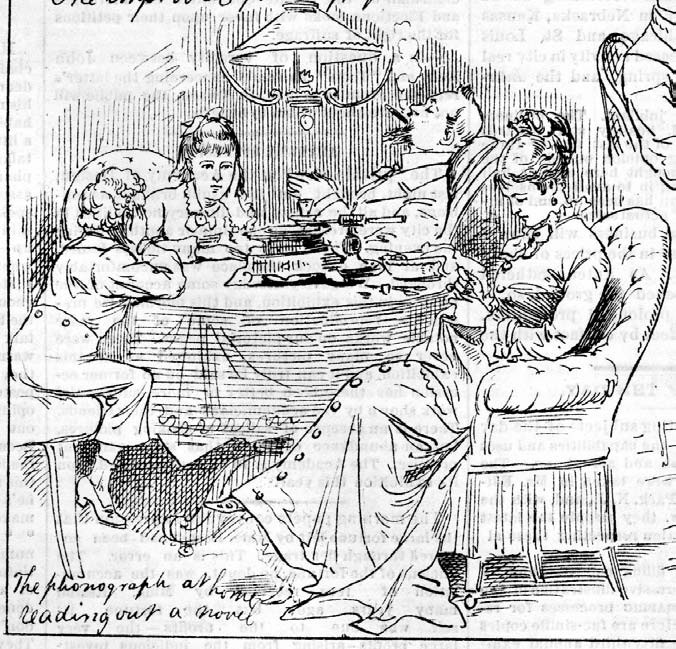
For a long time, people were suspicious of this convenience. Isn’t listening just letting yourself be carried along a little lazily, when truly reading would require the effort of the eye and silence? The reproach is old, and not entirely wrong — but it misses the point. A reading voice does something the silent page cannot: it gives the text a tempo, a breath, a texture. It hesitates, emphasizes, smiles. Listening to a story is not reading less well; it is reading differently, with someone.
That is precisely the gesture that strangers decided to make available to everyone, for free. In 2005, a project called LibriVox invited volunteers around the world to record, chapter by chapter, books that had entered the public domain. Twenty years later, there are tens of thousands of works read aloud — Sherlock Holmes, Jules Verne, the Grimm tales — by people simply offering their voices, in every language. The reader in the Cuban factory has not disappeared: he has multiplied by the thousands, and no one has to chip in for his wages anymore.
On Terondo, these voices have found a place alongside televisions, radios, and webcams from around the world. You can open a chapter read aloud there, without an account and without installing anything, and let it play as people once left the evening radio on. There is something a little dizzying about finding, on the newest of screens, the oldest of gestures: someone reading, and someone listening. Sometimes technology merely brings back what we thought we had lost.
1. Burgert Brothers Studio, Tampa / Florida Memory Project, State Archives of Florida — public domain — Public domain
2. The Daily Graphic (New York), April 2, 1878 — public domain — Public domain
3. National Archives and Records Administration (NARA), via the Digital Public Library of America — public domain — Public domain
Wikimedia Commons