MAGAZINE
From the agora to the news feed: how each generation gets its news
We have always wanted the same thing: to know what is happening, and to know whether it is true. What changes is the messenger, the speed, and whoever sorts things out for us. A journey in six stops, from the Greek listening to a speaker in the public square to the young person swiping a thumb across a screen, followed by a look at what lies ahead.
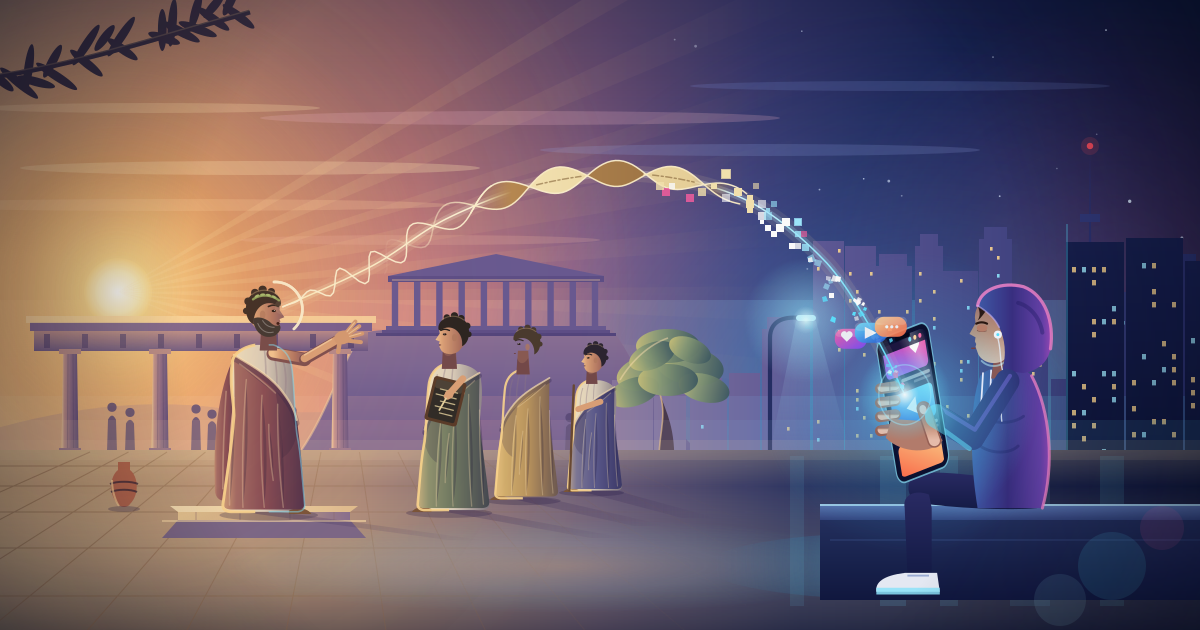
Athens, 5th century BCE: voice, legs and fire
In Athens, news is spoken. You hear it in the agora, the great square where people trade and debate and where heralds proclaim the city’s decisions. You hear it from a speaker at the people’s assembly on the Pnyx hill. Knowing what is happening means being there, standing among others, ears pricked.
When news comes from far away, it travels on foot. In 490 BCE, the messenger Pheidippides is said to have covered about 240 kilometres between Athens and Sparta to ask for help before the Battle of Marathon; Herodotus says he arrived the day after setting out. And when it needs to travel faster still, fires are lit: in Aeschylus’s Agamemnon, a chain of beacons, from peak to peak, brings news of Troy’s fall to Argos in a single night.
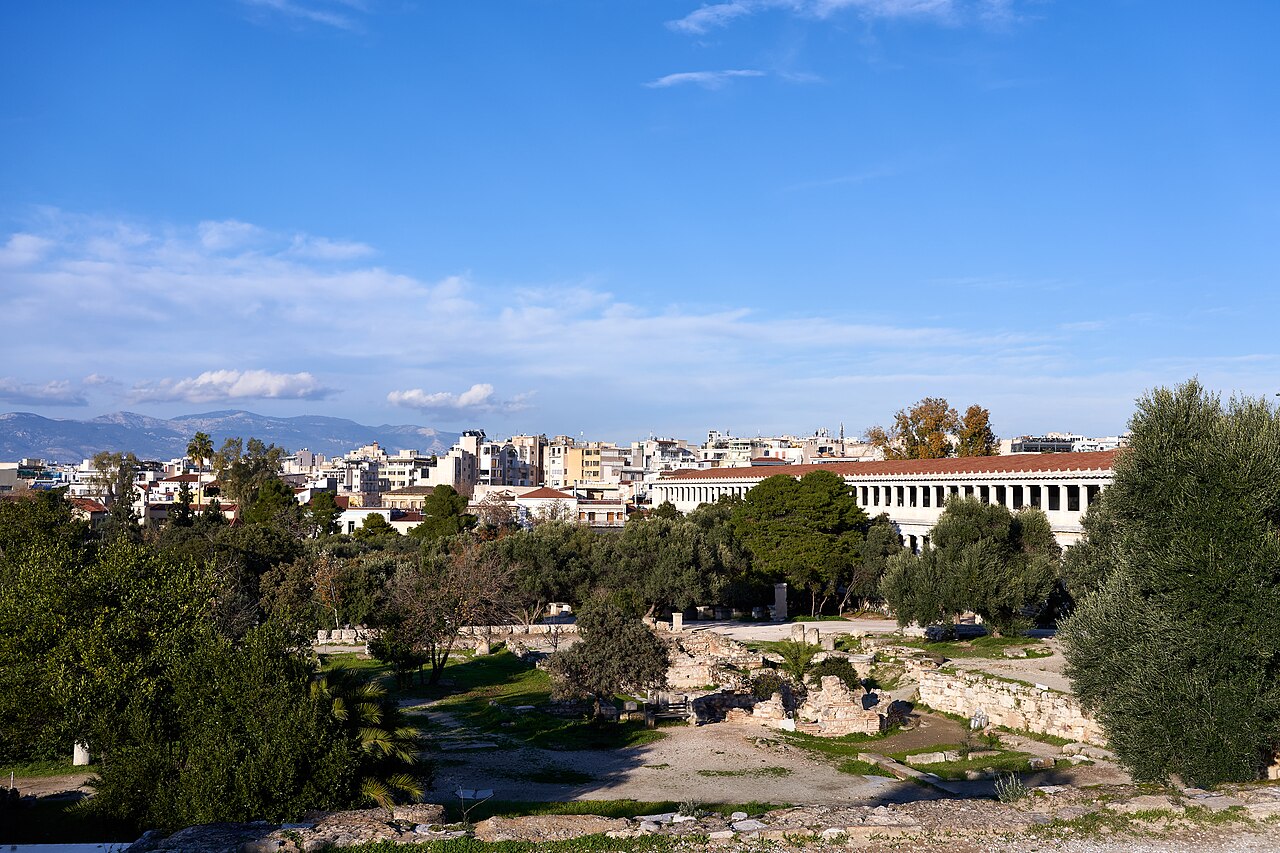
The Greeks were already wary of their own inventions. In the Phaedrus, Plato has Socrates tell the story of an Egyptian king who reproaches writing for giving people the appearance of knowledge without memory. Nearly twenty-four centuries later, the same debate is taking place about screens. And it is a Greek, Herodotus, who opens his book by announcing his account of his «inquiry»—historía in Greek, the word from which our “history” comes. For him, inquiry means travelling, observing, questioning, and then telling the story.
Middle Ages: the bell, the town crier and the merchant’s letter
In the Middle Ages, people get their news in groups, at set times, and rarely by choice. On Sundays, the sermon stands in for a newspaper: the priest says what people should believe, but also what the lord or king has decided. At the crossroads, the town crier reads ordinances aloud. The bell announces the hour, a feast day, a fire or an alarm. At the market and the inn, people pick up what travellers, pilgrims and minstrels have to tell.
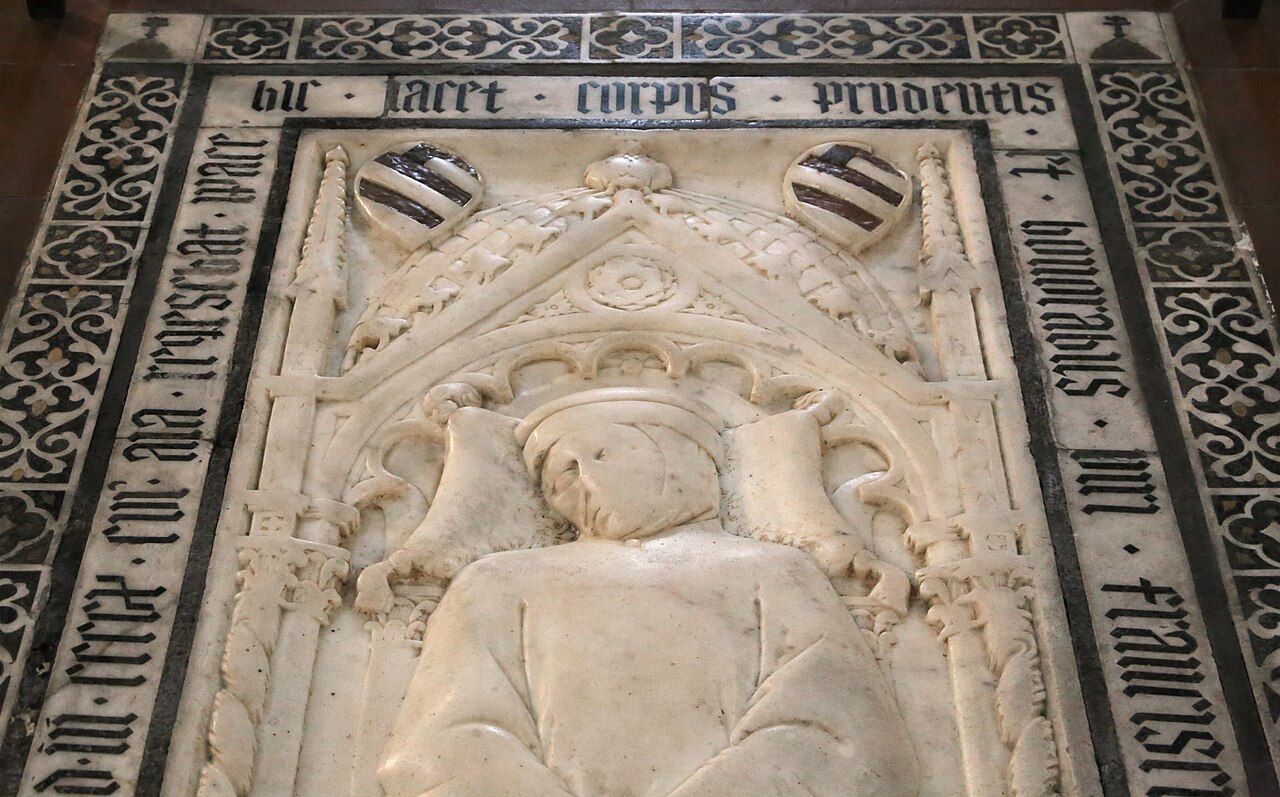
For business, a proper messaging network takes shape. The Tuscan merchant Francesco Datini (1335-1410) left behind around 143,000 letters, exchanged between nearly 300 cities: prices, wars, storms and harvests. Regular couriers linked Florence with Bruges and Barcelona, among other places. News takes days to arrive, often weeks, and comes with a question: is it still true?
Then everything speeds up. Around 1450, Gutenberg’s printing press circulates the same text in hundreds, then thousands of copies; the first French gazette appears in 1631; the telegraph, radio and television follow. Each time, news travels faster and farther; each time, someone worries. To see what the press used to look like, visit Terondo’s kiosk of old newspapers.
1976: the evening appointment
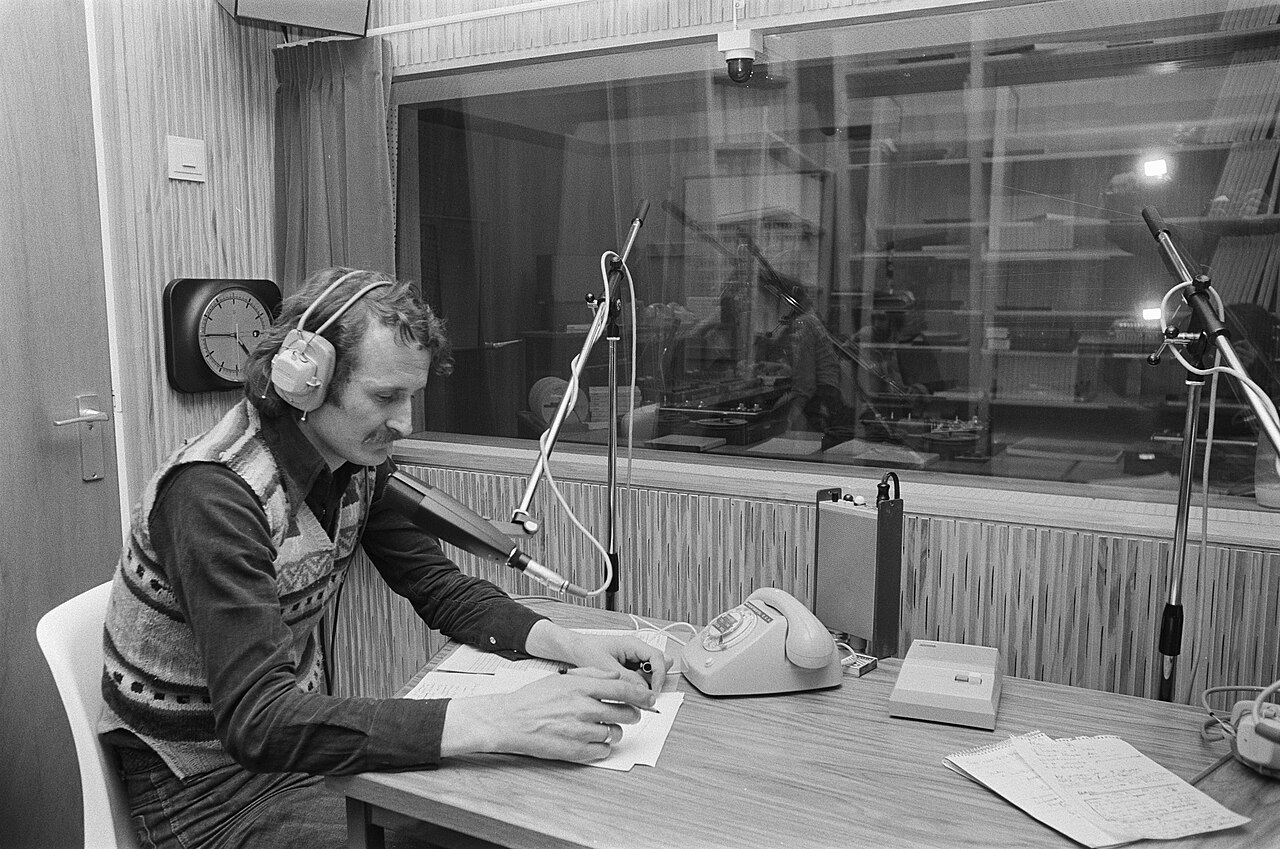
Fifty years ago, getting the news was an appointment. The newspaper arrived in the morning with the coffee. The radio on the kitchen table gave the headlines at a set time. And in the evening, the family gathered in front of the television news: in French-speaking Switzerland, Téléjournal has existed since 1 November 1954, and at first it lasted only fifteen minutes.
Few channels, few voices, and a newsroom deciding what matters: you do not choose, you receive. The price of this scarcity is dependence on those who sort the news. Its benefit is common ground: everyone has seen the same thing, and the next day they talk about it at the office, in the café or in the schoolyard.
For more on radio as a shared ritual, read The evening the whole world listened; on the generation that grew up with the transistor radio, read Before the meme: the generation that invented youth.
2006: the web arrives, the smartphone has not yet
Twenty years ago, people got their news on a desktop computer, on a newspaper’s website or a portal, and began choosing their sources: blogs, RSS feeds and online videos. 2006 was a turning point. Twitter launched in July. Facebook opened to everyone in September and introduced its news feed. In October, Google announced its acquisition of YouTube for 1.65 billion dollars. The smartphone did not arrive until a year later, with the iPhone.
For the first time, news no longer flowed only from a newsroom: it circulated among us. The speed shifted from hours to minutes, and the work of sorting passed quietly from journalists to algorithms and our friends.

2026: the feed, the video and the assistant
Today, news comes looking for us. According to the Reuters Institute’s Digital News Report 2026 (nearly 100,000 people surveyed in 48 markets), social media and video platforms are, for the first time, the most common way to access news online: 54% of people use them each week, ahead of media outlets’ own websites and apps (51%). 77% watch news videos every week. Creators and influencers have taken their place alongside newsrooms.
A newcomer is also joining in: the artificial intelligence assistant. Each week, 10% of respondents use one to get the news, compared with 7% a year earlier, and the figure is 16% among those under 35.

In many families, generations no longer live in the same news stream: grandparents stick with the evening news or the radio, parents move between apps and newsletters, and teenagers watch short videos. The price of abundance is trust: it has fallen to 37%, its lowest level since the report began measuring it, and is down in 29 of 48 markets.
Tomorrow: three scenarios, no predictions
No one knows how we will get our news in 2036. Newsrooms are preparing for it. In the same institute’s 2026 trends report, 280 media leaders from 51 countries expect their traffic from search engines to fall by 43% within three years, because assistants will answer directly instead of providing links.
Run the same news story through every era and the trend is clear: faster and faster, more and more personal.
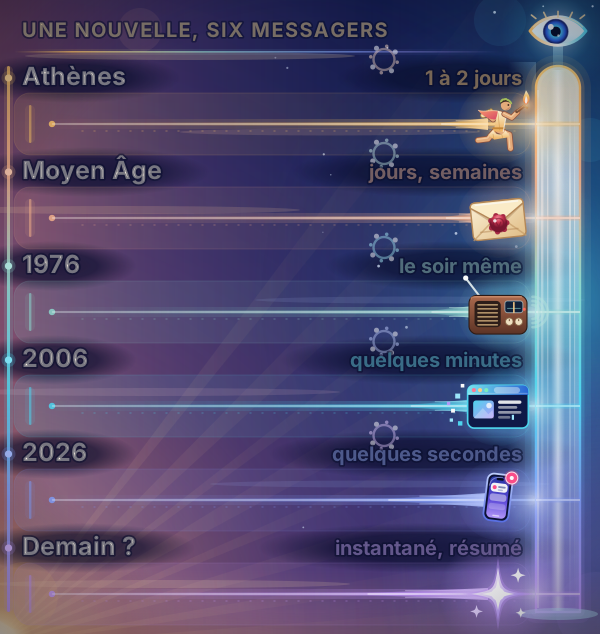
Three scenarios are emerging, and they may well overlap:
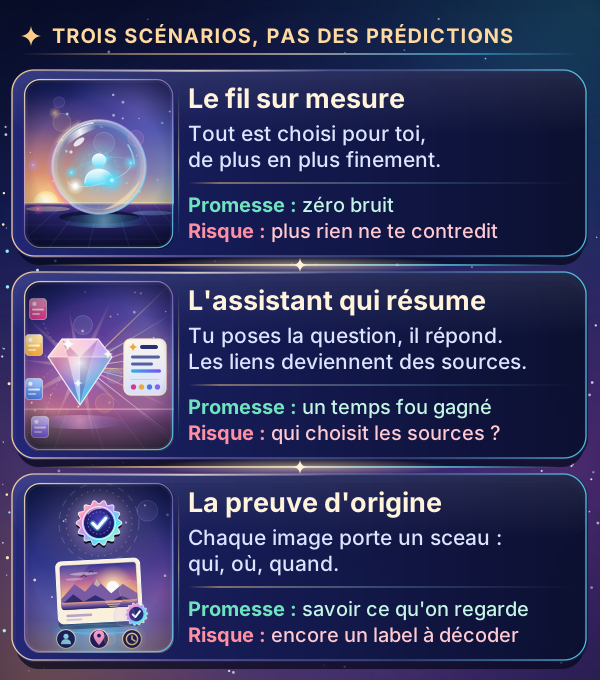
- The tailored feed. The algorithm learns what keeps us engaged and shows us only that. No noise, but no one left to contradict us.
- The summarising assistant. We ask a question and get an answer; articles become sources. A huge time-saver, provided we know who chooses the sources and who pays them.
- Proof of origin. Standards already exist for attaching the history of how a photo or video was made («content credentials»). If these seals become widespread, knowing where an image comes from will become as valuable a reference point as the image itself.
Four issues recur behind these scenarios:
- Trust: who should we believe when anything can be fabricated?
- Pluralism: how do we stay exposed to things that unsettle us?
- Funding: if no one clicks any more, who pays journalists?
- Education: learning to verify information at any age is becoming a basic skill.
What does not change
Between the agora and the feed, one thing remains constant: we want to see for ourselves. That is Herodotus’s approach, our Greek investigator: go there, look and listen before telling the story. The radios, televisions and webcams from around the world that Terondo brings together offer a modest way to return to it: listen live to a station in Athens, open a webcam overlooking a port on the other side of the world, without a filter or commentary. Every generation has its tool; curiosity stays the same.
Try it now
- Listen to radio stations around the world
- Watch television channels
- Browse old newspapers
- Also read When we read aloud
Sources: Reuters Institute for the Study of Journalism, Digital News Report 2026 and Journalism, media, and technology trends and predictions 2026; Herodotus, Histories, I (opening) and VI; Plato, Phaedrus; Aeschylus, Agamemnon; archives of the Datini company, Prato; Radio Télévision Suisse, history of Téléjournal.
Credits: illustrations, Terondo. Photos: Athenian agora, George E. Koronaios, CC BY-SA 4.0; Middle Ages, Sailko, CC BY 3.0; 1976, Bert Verhoeff / Anefo, Nationaal Archief, CC0; 2006, nikoretro, CC BY-SA 2.0; 2026, Rawpixel Ltd, CC BY 2.0. All via Wikimedia Commons.