Audiobook · read by volunteers
Fables for the Frivolous
Guy Wetmore Carryl (1873–1904)
Read by chriss the girl, Khoa Tran, Peter Katt, Noam Yogev, David Barnes, Betsie Bush, Kara Shallenberg (1969-2023), Denny Sayers (d. 2015), Joyce Nussbaum, Gesine · 20 chapters · 52 min
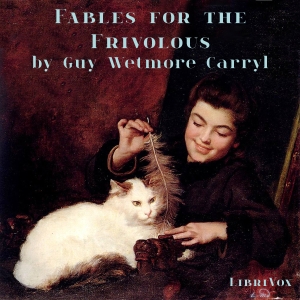
About the book
Take the old fables of La Fontaine, set them to bouncing verse, and give each one a moral and a pun that arrives with a groan and a smile. That is the recipe Guy Wetmore Carryl followed in 1898. His tortoise is persevering and his hare pretentious, his fox is sycophantic and his raven gullible, and his titles alone, with their gloriously mismatched adjectives, will have you grinning. Twenty short poems, each a miniature comedy, are read here by ten voices, so the collection moves briskly from one to the next. Carryl, an American humorist who died at only thirty-one, wrote them in a spirit of pure fun. At barely an hour in all, it is light, clever and funny, a delightful companion for lovers of nonsense, wordplay and a good old-fashioned moral twist.
Introduction
Guy Wetmore Carryl, who lived from 1873 to 1904, was an American parodist and the son of Charles Edward Carryl, the author of Davy and the Goblin, and Fables for the Frivolous, published in 1898, is among his earliest works. The book adapts fables from the writings of Jean de La Fontaine, which had already been popular for two centuries. Carryl retells them in verse with a lightness and cheek that make them quite unlike their models.
Each fable ends with a moral and a pun, and the humour often depends on the contrast between a dignified old tale and a deliberately offhand tone. The titles are part of the fun. Among them are The Arrogant Fox and the Unapproachable Grapes, The Persevering Tortoise and the Pretentious Hare, The Patrician Peacocks and the Overweening Jay, and The Rude Rat and the Unostentatious Oyster. The pairing of adjectives with animals gives a hint of what to expect: elegant diction put to comic use.
The collection has 20 pieces in the recording, each one occupying its own short track, and the total running time is a little under an hour. Because they are written in rhyme, the poems are well suited to being read aloud, and they work equally well when heard in small groups or in one sitting.
Ten LibriVox volunteers share the reading, and the variety of voices keeps the verses lively. The book is a good choice for adults who enjoy wordplay and for young listeners who like animal stories with a twist. It is also a reminder that parody can be a form of affection for the thing it teases.
Public domain
Guy Wetmore Carryl died in 1904: the work is in the public domain in Switzerland, more than 70 years after the author’s death.
The LibriVox volunteers dedicated this recording to the public domain.
Sources : LibriVox page · Files at the Internet Archive · Original text