Audiobook · read by volunteers
Aesop's Fables, Volume 05 (Fables 101-125)
Aesop (620–564 BC)
Read by Ted McElroy, Lee Dunkelberg, Vicki Barbour, Christine Dewar, Henry Frigon · 25 chapters · 32 min
About the book
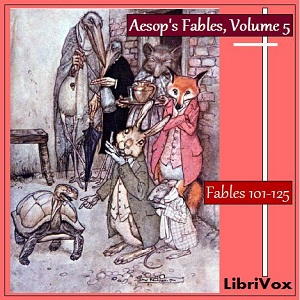
Imagine twenty-five tiny theatres, each with a cast of animals and a single lesson to teach. That is volume 5 of Aesop’s Fables, covering numbers 101 to 125. Here the Hare races the Tortoise, Hercules tells a stuck waggoner to put his shoulder to the wheel, an eagle is brought down by an arrow feathered with his own plume, and three bulls learn too late what it costs to quarrel. Others are quieter: The Old Woman and the Wine-Jar, The Goat and the Vine, The Two Pots. In V. S. Vernon Jones’s crisp English each story takes barely a minute, and its moral is stated plainly enough for a child to repeat. Five LibriVox volunteers share the reading, so the voice changes often across half an hour of easy, thoughtful listening. Whether you grew up with these tales or are meeting them for the first time, one or two will probably stay with you all day.
Introduction
Few names in literature are as famous as Aesop, and few are as hard to pin down. The traditional dates place him in the sixth century BC, but almost nothing is known about his life, and the fables survive in countless retellings, in many languages and many forms. They are short, they are about creatures that talk, and they end with a moral.
The LibriVox project divided its recording into twelve volumes of about twenty-five fables each. Volume 5 contains fables 101 to 125, read from the English translation of V. S. Vernon Jones, published in 1912. His version is known for its economy and good humour, and it keeps the moral at the end of every story, where a listener can weigh it. Among the fables here are The Hare and the Tortoise, The Eagle and the Arrow, The Lion and the Three Bulls and The Old Woman and the Wine-Jar, which show how widely the collection ranges: from boasting and bad luck to the strength of staying together.
Each fable is a separate chapter, and the volume lasts around half an hour in total. The reading is shared among five volunteers, so you hear a different voice at almost every turn. No knowledge of the earlier volumes is needed.
Fables like these reward repeated listening. Their brevity makes them easy to remember, and their situations, the boastful, the greedy and the foolish meeting their match, are timeless. Parents will find them useful for bedtime, teachers for the classroom and everyone else for a pleasant half hour. You can take the volume in a single sitting or one fable at a time.
Public domain
Aesop died in 564 BC: the work is in the public domain in Switzerland, more than 70 years after the author’s death.
The LibriVox volunteers dedicated this recording to the public domain.
Sources : LibriVox page · Files at the Internet Archive · Original text